


Learning how to prevent vehicle rust comes down to controlling three things: moisture, road salt and exposed metal. Wash salt and grime from the vehicle regularly, protect vulnerable metal with rustproofing or coatings, repair paint damage quickly, keep drainage points clear and inspect the underbody for early corrosion. For Canadian drivers, these steps matter even more because winter road salt, slush and repeated freeze-thaw cycles create ideal conditions for corrosion.
Rust prevention works best as ongoing vehicle maintenance, not a one-time treatment.
Why Do Vehicles Rust?
Rust forms when iron in steel reacts with oxygen and moisture. The process creates iron oxide, commonly called rust.
Road salt makes the situation worse. When salt dissolves in water, it creates a conductive solution that accelerates the electrochemical corrosion process. That is why areas exposed to salty winter spray often deteriorate faster than protected exterior panels.
Environment and Climate Change Canada reports that road salts are widely used across Canada for de-icing and anti-icing. Approximately five million tonnes are spread on Canadian roads in a typical year.
Citation suggestion: Environment and Climate Change Canada, Road Salts Code Implementation.
Modern vehicles already have several layers of corrosion protection, including paint, primers, galvanized components and factory coatings. These barriers can still become damaged by stone chips, scratches, road debris, age and normal wear.
Once moisture and salt reach exposed metal, corrosion can begin.
Where Does Rust Usually Start on a Vehicle?
Rust does not always begin where you can easily see it.
The most vulnerable areas tend to be places exposed to road spray or locations where moisture can remain trapped:
- undercarriage
- frame rails and subframes
- wheel wells
- rocker panels
- lower door edges
- door seams
- trunk and hatch seams
- around drain holes
- suspension mounting areas
- brake and fuel lines
- floor pans
- areas behind plastic liners and trim
- paint chips around the hood and fenders
The underside deserves particular attention.
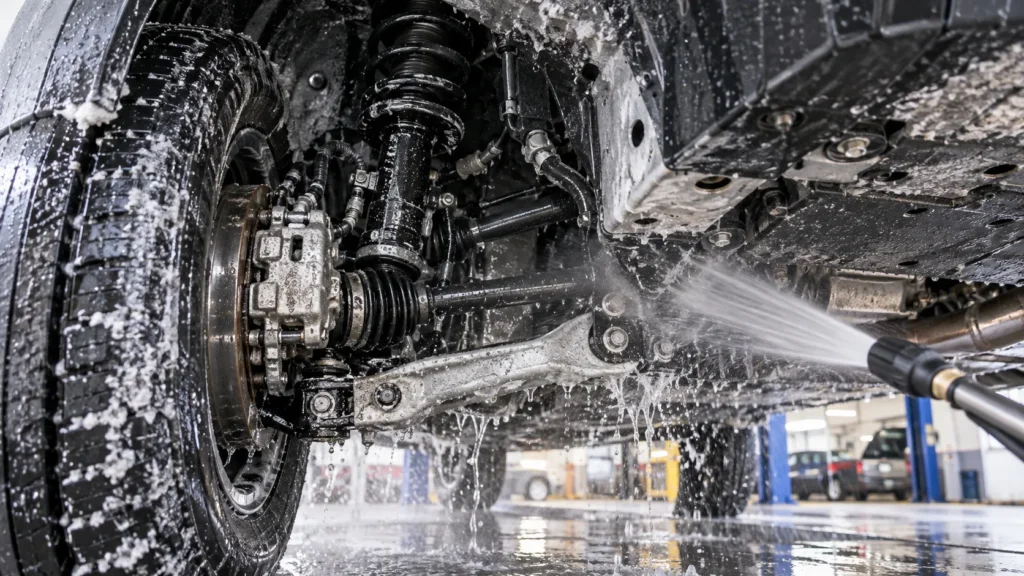
CAA notes that road salt, slush and temperature changes can affect components such as the frame, brake lines, fuel lines, suspension and wheel wells. Many of these areas remain out of sight during normal vehicle use.
Citation suggestion: CAA, vehicle undercarriage maintenance guidance.
Surface corrosion on a visible body panel is one problem. Corrosion affecting structural or safety-related components is considerably more serious.
How to Prevent Vehicle Rust: 8 Practical Steps
The most effective approach combines cleaning, inspection and protective treatments.
1. Wash Road Salt Off Regularly
Regular washing is one of the simplest ways to reduce corrosion risk.
During Canadian winters, salt and brine collect underneath the vehicle and around wheel wells, rocker panels and suspension components. Washing removes these contaminants before they remain on the surface for extended periods.
Do not focus only on the visible paint.
Choose a wash that reaches:
- the undercarriage
- wheel wells
- lower body panels
- behind mud flaps
- around rocker panels
CAA specifically recommends frequent vehicle washing that includes an undercarriage wash as part of winter rust prevention.
Citation suggestion: Canadian Automobile Association, Winter Car Care.
There is no universal washing schedule because exposure varies. A vehicle driven daily on heavily salted roads needs cleaning more often than one used occasionally in dry conditions.
A practical rule is to wash the vehicle after significant exposure to salt and slush rather than waiting until the body looks dirty.
2. Pay Special Attention to the Undercarriage
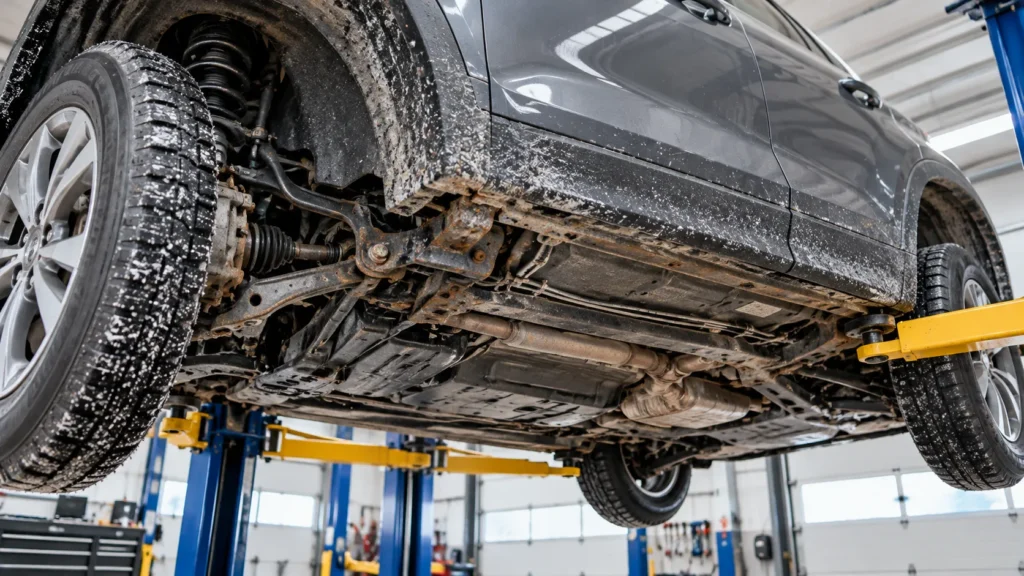
The underbody receives direct exposure to water, road salt, gravel and debris.
Yet many drivers rarely inspect it.
An underbody rinse can help remove contamination from exposed surfaces, wheel wells and chassis components. It becomes especially useful during winter and at the end of the salt season.
A thorough spring cleaning is also worthwhile. Salt residue can remain in hidden areas even after snow disappears.
Check the underside for:
- orange or brown corrosion
- peeling factory coatings
- damaged seam sealer
- exposed metal
- heavy flaking
- corrosion around brake or fuel lines
- rust around mounting points
Light surface corrosion and severe structural corrosion are not the same problem. If metal is heavily scaled, perforated or weakened, have the area inspected professionally rather than simply coating over it.
3. Consider Professional Rustproofing
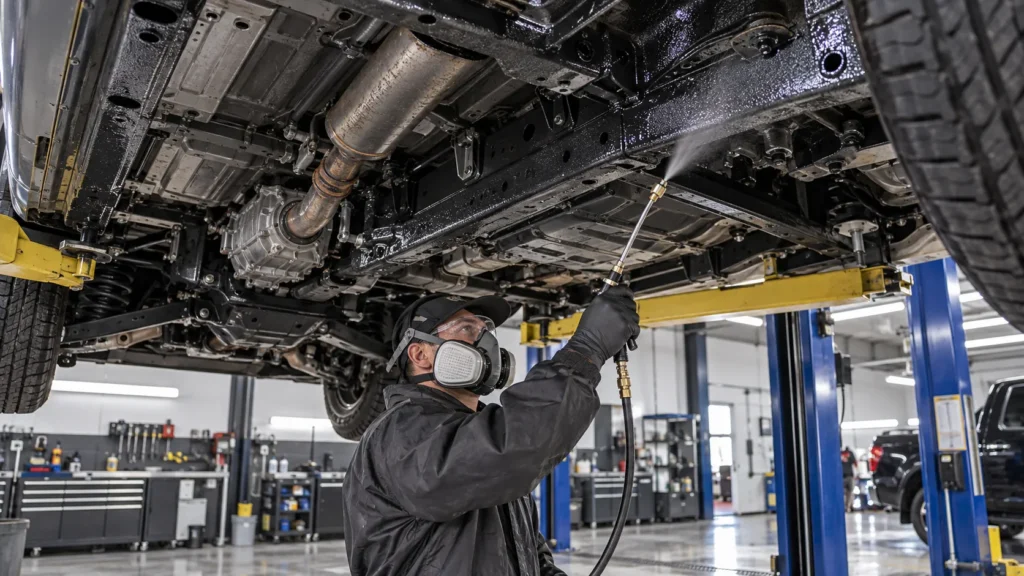
Rustproofing for a car adds another barrier between vulnerable metal and corrosive conditions.
Different systems work differently. Common approaches include oil-based or creeping rust inhibitors, wax-like coatings and more permanent barrier-style undercoatings.
A professionally applied rustproofing treatment may reach places that ordinary washing and exterior paint protection cannot, including seams, cavities and hidden body panels.
Drivers who regularly travel on salted roads may find professional Rustproofing services particularly useful as part of a broader corrosion-prevention plan.
Rustproofing does not mean that you can stop washing or inspecting the vehicle. The coating becomes one layer in the protection system.
Oil or creeping rustproofing
These products are designed to spread into seams and cavities.
Advantages:
- can reach difficult areas
- remains flexible
- may displace moisture depending on the formulation
- useful around seams and joints
Potential drawbacks:
- some products can drip after application
- periodic reapplication may be required
- treatment schedules vary by manufacturer
Wax or semi-solid corrosion protection
These treatments create a protective film on metal surfaces.
Advantages:
- good resistance to water and road contamination
- less dripping after curing
- useful on exposed underbody components
Potential drawbacks:
- coverage quality matters
- damaged areas may require inspection or touch-up
- service intervals depend on the product
Hard or rubberized undercoating
These products create a more rigid physical barrier.
They can work well when the metal has been prepared correctly and the coating remains intact. Problems can occur when a rigid coating cracks, separates or is applied over moisture, dirt or existing corrosion.
The condition of the metal before application matters as much as the coating itself.
If you are deciding between these systems, our guide Is Rustproofing Worth It can help explain the costs, maintenance requirements and suitability for different vehicles.
4. Repair Paint Chips and Scratches Early
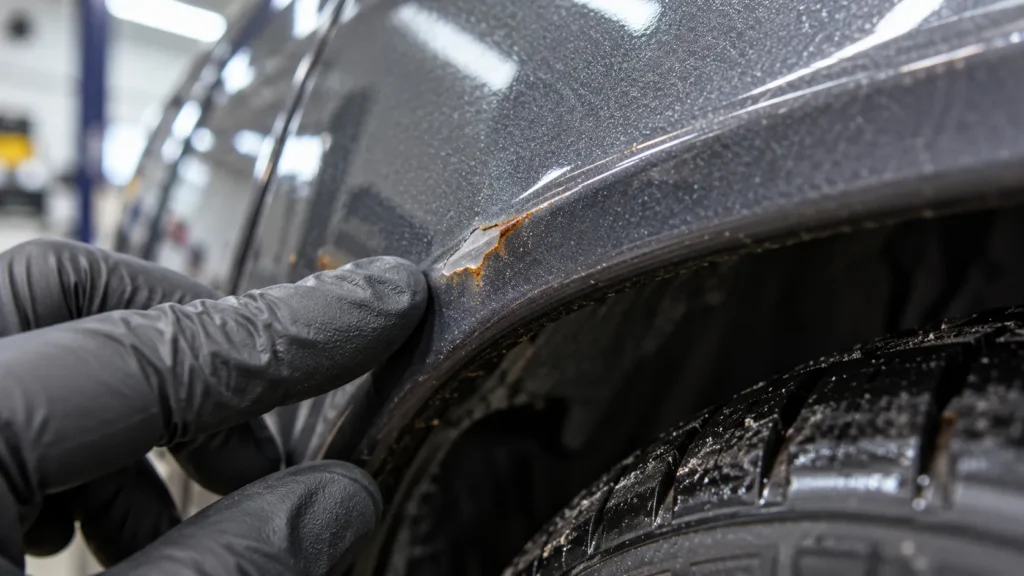
Your vehicle’s paint does more than improve its appearance. It separates the underlying steel from moisture and oxygen.
Stone chips can break that barrier.
Pay close attention to:
- hood edges
- front fenders
- wheel arches
- doors
- rocker panels
- roof edges
- trunk or hatch openings
A small paint chip may be inexpensive to repair while it remains clean and corrosion-free.
Once rust forms underneath the surrounding paint, the repair becomes more involved.
Use touch-up paint that matches the vehicle manufacturer’s paint code for minor chips where appropriate. Larger damaged areas or active corrosion may require professional body repair.
CAA also recommends repairing small scratches caused by road salt or stones as part of spring vehicle maintenance.
Citation suggestion: CAA, Spring Maintenance Tips.
5. Keep Door and Body Drain Holes Clear
Vehicles contain drainage pathways that allow water to escape from doors, rocker panels and other cavities.
Mud, leaves, rustproofing residue and debris can block these openings.
When that happens, moisture may remain inside a panel where you cannot see it.
Check drainage points periodically, particularly around:
- bottoms of doors
- rocker panels
- trunk or hatch areas
- sunroof drains, where applicable
If you do not know where your vehicle’s drain points are located, consult the owner’s manual or ask a qualified technician.
Avoid aggressively pushing metal objects into drains because you could damage paint, seals, wiring or internal components.
6. Protect the Exterior Paint
Wax, synthetic paint sealants and ceramic coatings can help keep contamination from bonding directly to the painted surface.
They are useful, but they should not be confused with underbody rustproofing.
Paint protection primarily protects exterior painted surfaces. Rustproofing targets vulnerable metal, cavities, seams and underbody areas.
A well-maintained exterior coating can help by:
- making contaminants easier to remove
- improving water repellency
- protecting the clear coat
- reducing direct exposure of damaged or weathered surfaces
No paint coating can protect a stone chip that has already exposed bare steel unless the damaged area itself is repaired.
7. Keep the Interior Dry
Rust can also develop from the inside.
Snow from boots melts into carpeting during Canadian winters. Water can then remain underneath mats or carpet for long periods.
Use properly fitted all-weather mats and remove accumulated water regularly.
Check for unexplained dampness around:
- front footwells
- rear carpets
- spare-wheel wells
- trunk liners
- door seals
Persistent moisture may indicate a leaking weather seal, drain, windshield or body seam.
Finding the leak early protects more than the carpet. It can prevent hidden floor-pan corrosion.
8. Inspect the Vehicle at Least Seasonally
Rust is much easier to manage when caught early.
A practical inspection schedule includes one check before winter and another after the main road-salt season.
Look at the:
- wheel arches
- rocker panels
- bottoms of doors
- undercarriage
- frame or subframe
- brake lines
- fuel lines
- exhaust mounting areas
- suspension mounting points
Also look for bubbling paint.
Paint bubbles can indicate corrosion developing underneath the finish even when the surface has not opened yet.
If you are buying a used vehicle in Canada, an underbody corrosion inspection should also form part of your pre-purchase evaluation.
Should You Wash Your Car After Rustproofing?
Yes, but when you should wash a car after rustproofing depends on the product that was applied.
Some corrosion inhibitors allow normal exterior washing immediately after treatment. Corrosion FREE, for example, states that vehicles can be washed after treatment but recommends avoiding underbody sprays containing degreasers because they can reduce the product’s longevity.
Other coatings may need time to settle, cure or develop their protective film.
Citation suggestion: Corrosion FREE product FAQ.
The safest approach is simple:
- Ask what type of rustproofing product was applied.
- Follow the manufacturer’s or installer’s curing instructions.
- Avoid unnecessarily aggressive underbody washing immediately after treatment.
- Do not use strong degreasers on treated areas unless the product manufacturer says they are safe.
A regular exterior wash and a high-pressure underbody wash are not the same thing.
If you are unsure, ask your rustproofing provider specifically:
“When can I wash the body, and when can I pressure-wash the undercarriage?”
That question removes the ambiguity.
Should You Wash a Vehicle Before Rustproofing?
Usually, the application surface should not have heavy mud, packed dirt or loose contamination.
Exactly how clean or dry the vehicle needs to be depends on the rustproofing system.
Some moisture-displacing products can be applied to damp surfaces. Other coatings require clean, completely dry metal to bond correctly.
For example, Corrosion FREE recommends pressure-washing heavy mud and dirt from the frame and wheel wells before treatment when necessary.
Rust Check similarly advises owners of vehicles with significant mud or buildup to have it pressure-washed before application.
Citation suggestions: Corrosion FREE FAQ; Rust Check FAQ.
Do not assume that every rustproofing product has identical preparation requirements.
Can You Rustproof a Vehicle That Already Has Rust?
Sometimes.
Rustproofing may help slow further corrosion, but it does not rebuild metal that has already been lost.
The correct approach depends on the severity.
| Condition | Typical next step |
|---|---|
| No visible rust | Preventive protection |
| Light surface rust | Inspect, clean/treat as appropriate, then protect |
| Bubbling paint | Investigate corrosion beneath the finish |
| Heavy scaling | Professional inspection recommended |
| Holes or perforation | Repair may be necessary |
| Rust near structural or safety components | Professional assessment should come first |
Avoid simply hiding serious rust under a thick coating.
A coating can improve protection, but it cannot restore the strength of compromised steel.
When Is the Best Time to Rustproof a Car?
There is no single month when rustproofing suddenly becomes effective.
Many products can be applied throughout the year.
For Canadian drivers, treating the vehicle before prolonged winter salt exposure can be convenient because the protective layer is already in place when winter arrives.
That does not mean you must wait until autumn.
If your vehicle needs corrosion protection in spring or summer, there is little benefit in leaving vulnerable metal unprotected for several months simply to reach a particular season.
Product requirements matter more than the calendar.
Does Parking in a Garage Prevent Rust?
A garage can help protect a vehicle from rain, snow and direct weather exposure, but parking indoors does not make a vehicle rust-proof.
A wet, salt-covered vehicle can still corrode inside a garage.
Ventilation and moisture control matter.
The best sequence is:
remove salt → allow the vehicle to dry → maintain protective coatings → store it in suitable conditions.
Simply moving a contaminated vehicle into a warm enclosed space does not remove the salt underneath it.
For vehicles stored for long periods, humidity control becomes particularly important.
The Canadian Conservation Institute notes that lower relative humidity slows corrosion and that salts on metal surfaces can accelerate corrosion under humid conditions.
Citation suggestion: Canadian Conservation Institute, Caring for Vehicles.
Common Vehicle Rust Prevention Mistakes
Waiting until rust becomes visible
Some corrosion begins inside seams and cavities.
Visible rust may represent a later stage of the problem.
Routine inspection works better than waiting for orange spots.
Washing the body but ignoring the underside
A shiny hood tells you very little about the condition of your frame rails, brake lines or rocker panels.
Winter washing should include areas exposed to road spray.
Assuming rustproofing lasts forever
Many rustproofing systems require periodic inspection or reapplication.
Follow the schedule specified by the product provider rather than assuming one treatment gives permanent protection.
Applying a coating over loose rust and dirt
Barrier coatings work best when surface preparation meets the manufacturer’s requirements.
Covering contamination does not repair the metal beneath it.
Believing a ceramic coating replaces rustproofing
Ceramic coatings protect paint surfaces.
They do not automatically protect internal cavities, seams, frame components or hidden underbody metal.
The two services solve different problems.
Ignoring clogged drains
Water trapped inside a door or rocker panel can cause corrosion that progresses with very few visible warning signs.
What About Electronic Rust Protection?
Electronic rust-control systems deserve careful consideration.
Cathodic protection is a legitimate corrosion-control method in applications such as ships, pipelines and underground metal structures. A road vehicle, however, presents different electrical and environmental conditions.
Drivers should not assume that an electronic device replaces proven measures such as washing, surface protection, rustproofing and inspection.
If a shop recommends an electronic system, ask for:
- independent evidence specific to passenger vehicles
- warranty terms
- installation requirements
- limitations
- maintenance requirements
Treat extraordinary corrosion-protection claims cautiously when they are supported only by marketing material.
Rustproofing vs. Undercoating: Are They the Same?
Not always.
The terminology varies between manufacturers and service providers.
Rustproofing often refers to corrosion inhibitors applied to metal, seams and internal cavities.
Undercoating usually refers to material applied primarily to the underside of a vehicle to form a protective barrier.
Some professional services combine both approaches.
Before buying a service, ask exactly what areas will be treated rather than relying on the service name.
Questions to ask a rustproofing provider
Ask:
- What product do you use?
- Is it oil-based, wax-based or a hard coating?
- Are body cavities treated?
- Are rocker panels and seams treated?
- Is the frame or subframe treated?
- Will access holes be drilled?
- How long does the treatment last?
- When is reapplication required?
- Can I wash the car immediately afterwards?
- Can I use an underbody car wash?
- What does the warranty actually cover?
- How do you treat existing surface rust?
Clear answers are more valuable than claims that a treatment is simply “the best.”
A Simple Canadian Rust-Prevention Schedule
You do not need to think about rust every week of the year. A basic seasonal routine covers most of the important work.
Before winter
Inspect the paint and underbody.
Repair obvious chips and scratches, clear drainage points and check whether your rustproofing treatment needs renewal.
During winter
Wash salt and brine from the vehicle regularly.
Include the wheel wells and undercarriage where practical.
Remove wet snow and water from interior mats.
Early spring
Give the vehicle a thorough wash, including the underside, after the heavy salt season.
Inspect for new paint chips, bubbling, damaged coatings and corrosion.
Summer
Repair any corrosion or paint damage discovered during spring inspection.
Maintain exterior paint protection and keep drainage channels clear.
Autumn
Inspect the vehicle again before road-salt season begins.
This cycle makes rust prevention routine rather than reactive.
Is Vehicle Rust Only a Cosmetic Problem?
No.
Some rust is cosmetic, particularly minor surface corrosion on non-structural areas.
More advanced corrosion can affect components associated with vehicle safety and structural integrity.
Potentially significant areas include:
- frame or unibody structures
- suspension mounting points
- brake lines
- fuel system components
- structural rocker panels
- load-bearing mounting points
If rust is flaking heavily, creating holes or affecting a structural component, arrange a professional inspection.
Do not judge severe corrosion only by how it looks from outside.
Final Thoughts on How to Prevent Vehicle Rust
The best answer to how to prevent vehicle rust is not a single product. It is a maintenance system.
Remove road salt regularly. Keep the undercarriage clean. Repair paint damage before bare metal remains exposed. Keep drains open, control trapped moisture and inspect hidden rust-prone areas. Add suitable rustproofing when the vehicle’s use and environment justify it.
Canadian winters make corrosion prevention particularly important, but consistent maintenance can significantly reduce unnecessary exposure to the conditions that allow rust to develop.
Start before you see serious corrosion. Prevention is far easier than repairing metal that has already deteriorated.
Frequently Asked Questions
What is the best way to prevent a car from rusting?
Use several layers of protection rather than relying on one treatment. Regularly remove salt and dirt, wash the undercarriage, repair paint chips, keep drainage points clear, maintain paint protection and consider rustproofing for exposed or hidden metal areas.
How often should I wash my car to prevent rust?
There is no universal interval. Wash according to exposure. During periods of heavy road-salt use, clean the vehicle often enough that salt and slush do not remain accumulated underneath it for long periods. Include an underbody rinse when appropriate.
Does washing your car prevent rust?
Washing can reduce corrosion risk because it removes salt, dirt and other contaminants. For winter rust prevention, cleaning the wheel wells and undercarriage matters as much as washing visible exterior panels.
Should I wash my car after rustproofing?
Usually you can continue washing the vehicle, but the correct timing depends on the rustproofing product. Some products allow immediate washing, while certain coatings may require curing time. Avoid aggressive underbody degreasers or pressure washing until the installer confirms it is safe.
Can underbody washing remove rustproofing?
It can affect some treatments, particularly when strong degreasers or high-pressure cleaning methods are used. Ask your service provider which washing methods are compatible with the specific product applied to your vehicle.
Is rustproofing worth doing on a new car?
A new vehicle can still benefit from corrosion protection, particularly when it will be driven for many years in areas that use road salt. Consider the factory corrosion protection, how long you plan to keep the vehicle, local driving conditions, treatment type, warranty requirements and reapplication costs.
Is rustproofing worth doing on an older car?
It may be, provided the vehicle remains structurally sound. Rustproofing can help protect remaining metal, but it cannot repair severe corrosion or restore metal that has already disappeared. Inspect an older vehicle before treatment.
Can you put rustproofing over rust?
Some corrosion-inhibiting products are designed for use over light surface corrosion, but loose scale, structural rust and perforated metal need proper evaluation. Follow the product manufacturer’s preparation instructions rather than simply covering serious corrosion.
Does wax prevent car rust?
Wax helps protect painted exterior surfaces from water and contaminants. It does not provide complete protection for internal cavities, frame components or the entire underbody, so it should complement rather than replace broader corrosion prevention.
Does ceramic coating stop rust?
Ceramic coating can help protect intact painted surfaces, but it does not stop rust once metal has become exposed and does not replace cavity or underbody rustproofing.
Does road salt cause cars to rust?
Road salt accelerates corrosion by increasing the conductivity of moisture on metal surfaces. This makes regular salt removal particularly important for vehicles driven during Canadian winters.
What are the first signs of rust on a car?
Early signs include small orange-brown spots, bubbling paint, staining around seams, peeling coatings and surface corrosion underneath the vehicle. Flaking metal, perforation or corrosion around structural components indicates a more advanced problem.
Can rust be completely prevented?
No practical maintenance programme can guarantee that a daily-driven vehicle will never develop corrosion. You can, however, substantially reduce the conditions that encourage it through cleaning, protective coatings, moisture control, inspections and timely repairs.