


For most vehicles driven year-round on salted Canadian roads, you should inspect the rust protection every year and expect many oil-based or creeping rustproofing treatments to require annual reapplication. Longer-lasting wax, sealant, or undercoating systems may not need complete reapplication every year, but they should still be inspected regularly and touched up when protection becomes thin, damaged, cracked, or exposed.
The right schedule depends on the product, your climate, kilometres driven, road-salt exposure, vehicle condition, and how thoroughly the treatment was applied.
That distinction matters because rustproofing is not a one-size-fits-all maintenance service.
How Often Should You Rustproof Your Car? Quick Answer
| Driving situation | Practical approach |
| Daily driving through salted Canadian winters | Inspect annually; many oil-based systems are reapplied every year |
| Heavy winter commuting or frequent highway driving | Annual treatment is generally the safer approach |
| Wax or longer-lasting barrier coating | Inspect annually and reapply according to product condition and manufacturer instructions |
| Thick undercoating | Inspect annually for chips, cracking, separation, or exposed metal; repair as required |
| Low-mileage summer vehicle stored through winter | Follow the product schedule, but still inspect periodically |
| Coastal or consistently damp environment | Inspect annually because moisture and airborne salt can increase corrosion exposure |
| Used vehicle with unknown history | Have the underside inspected before choosing a treatment |
| Vehicle with existing rust | Repair or assess corrosion first; rustproofing cannot reverse structural damage |
The most useful rule is therefore not simply “rustproof every 12 months.”
A better rule is:
Inspect every year and renew the protection before vulnerable metal is left exposed to another high-salt season.
What Does Rustproofing Actually Do?
Rustproofing applies a corrosion-resistant material to areas of a vehicle that are vulnerable to moisture, oxygen, salt, dirt, and other contaminants.
Rust develops through an electrochemical corrosion process involving metal, oxygen, and moisture. Chloride salts can make conditions significantly more corrosive, which is one reason vehicles driven through Canadian winters deserve particular attention.
Environment and Climate Change Canada reports that approximately five million tonnes of road salts are spread on Canadian roads each year for winter road safety.
Suggested citation: Environment and Climate Change Canada — Road Salts Overview and Code Implementation.
Rustproofing products are commonly applied to areas such as:
- rocker panels;
- wheel wells;
- body seams;
- door cavities;
- frame or subframe areas;
- floor-pan seams;
- inner fenders;
- mounting points; and
- other exposed or corrosion-prone metal.
A penetrating rustproofing spray can reach seams and cavities that are difficult to protect with exterior paint alone.
However, rustproofing does not make a vehicle permanently immune to corrosion. Road debris, pressure washing, ageing, temperature changes, repairs, abrasion, and normal driving can gradually reduce protection.
Why Canadian Vehicles Need More Frequent Attention
Rust protection schedules found online are often written as though every driver faces the same conditions.
Canadian drivers do not.
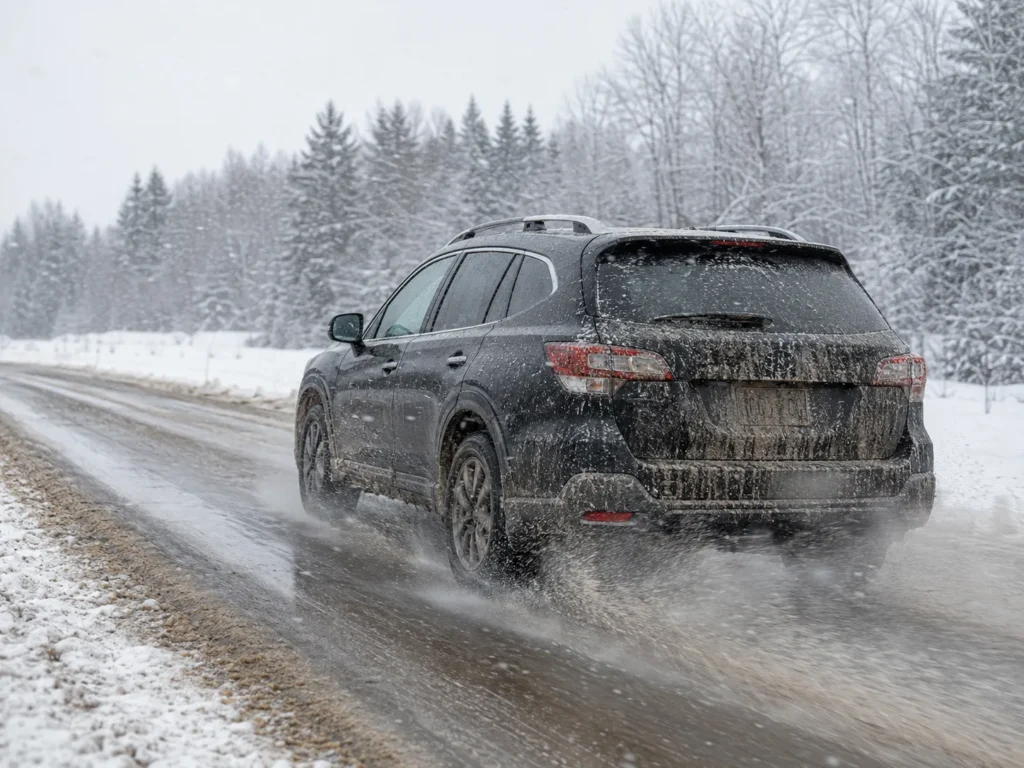
Winter maintenance creates particularly demanding conditions because vehicles repeatedly encounter combinations of:
- road salt and de-icing chemicals;
- wet slush;
- snow;
- freezing and thawing;
- standing moisture;
- gravel and road debris;
- paint chips;
- dirt accumulation; and
- wet wheel wells and underbody cavities.
Government of Canada information confirms the widespread use of road salts for winter road maintenance, while Transport Canada recalls have documented situations where corrosion associated with heavy road-salt environments affected components such as subframes and steering-related hardware.
Suggested citations:
Environment and Climate Change Canada — Road Salts Overview.
Transport Canada Motor Vehicle Safety Recalls Database — corrosion-related recalls.
That does not mean every rusty component will become a safety problem. It does show why corrosion should be viewed as more than a cosmetic concern.
The Type of Rustproofing Determines the Reapplication Schedule
One of the biggest mistakes car owners make is assuming that every rustproofing product lasts the same amount of time.
It does not.
Penetrating or Oil-Based Rustproofing
Penetrating oil treatments are designed to creep into seams, joints, folds, and cavities.
Their ability to remain mobile is useful because corrosion often begins in areas that are difficult to see.
The trade-off is that these products gradually wear away or migrate.
For vehicles driven through regular Canadian winter conditions, annual application is common for this type of treatment.
Independent Canadian automotive consumer guidance from the Automobile Protection Association also discusses annual treatment for penetrating oil-based systems.
Suggested citation: Automobile Protection Association — Rustproofing.
Dripless or Thicker Rustproofing Spray
Dripless products generally remain where they are applied more readily than very thin creeping oils.
Depending on the formulation, they may offer longer persistence on exposed surfaces but penetrate tight seams differently.
Do not assume that “dripless” automatically means better or worse.
Coverage quality matters more.
Ask:
- Does the product reach enclosed cavities?
- Is it compatible with existing factory coatings?
- Does it remain flexible?
- How often does the manufacturer require inspection?
- What parts of the vehicle are excluded from spraying?
Follow the actual product specifications rather than a generic online interval.
Wax and Cavity-Wax Protection
Wax-based corrosion protection creates a barrier between metal and moisture.
Quality cavity waxes are used in automotive manufacturing and repair, but condition matters. Damage, drying, abrasion, or separation can reduce protection.
Annual inspection is still sensible even when full reapplication is not required annually.
Rubberized or Thick Undercoating
Undercoating and rustproofing are related, but they are not identical.
A thick underbody coating protects exposed surfaces from moisture, debris, gravel, and abrasion. It may remain effective longer than a thin oil spray.
However, damaged barrier coatings deserve attention.
If a coating becomes separated or compromised and contaminants reach the metal underneath, simply spraying more material over the problem may hide rather than solve it.
That is why a good service provider inspects before reapplying.
Rustproofing vs Undercoating: What Is the Difference?
The terms are often used interchangeably, which creates unnecessary confusion.
| Rustproofing | Undercoating |
| Primarily targets corrosion | Provides corrosion and physical underbody protection |
| Often uses penetrating oil, wax, or corrosion inhibitors | Usually creates a thicker barrier |
| Can reach seams and enclosed cavities | Concentrated mainly on the vehicle underside |
| Particularly useful where moisture collects internally | Useful against road spray, stones, salt, and abrasion |
| Frequently renewed depending on formulation | Often touched up according to coating condition |
| May remain soft or mobile | Commonly forms a more durable surface layer |
When comparing rustproofing vs undercoating, neither should automatically be considered superior.
They solve slightly different problems.
A well-designed corrosion-control programme may use penetrating material inside seams and cavities while using a more abrasion-resistant coating on appropriate exposed underbody surfaces.
What Factors Determine How Often Your Car Needs Rustproofing?
1. Road-Salt Exposure
Salt exposure is one of the strongest reasons to shorten the maintenance interval.
A vehicle commuting throughout winter usually deserves more frequent attention than a collector car that remains in storage from November through April.
2. Annual Kilometres
More kilometres usually mean more exposure to:
- road spray;
- gravel;
- dirt;
- puddles;
- construction debris;
- winter slush; and
- abrasion.
A vehicle travelling 30,000 kilometres a year may wear through protective material differently from a car travelling 5,000 kilometres.
3. Where the Vehicle Is Driven
A car used primarily on clean urban roads faces different conditions from:
- a rural pickup;
- a construction vehicle;
- a highway commuter;
- a delivery vehicle;
- an off-road SUV; or
- a vehicle regularly exposed to coastal air.
Frequency should reflect exposure, not simply age.
4. Vehicle Age
New cars already contain factory corrosion-protection measures such as coatings, sealers, drainage design, protected metal, and corrosion-resistant materials.
That helps—but factory protection is not the same as permanent immunity from corrosion.
As vehicles accumulate stone chips, repairs, scratches, worn coatings, and winter exposure, additional prevention may become more valuable.
5. Existing Corrosion
An older vehicle does not automatically need more rustproofing.
It needs a better inspection.
Light surface corrosion may be manageable.
Heavy scaling, perforation, weakened mounting areas, or structural deterioration should be inspected and repaired appropriately before anyone simply covers the area with another coating.
6. Previous Treatment
Do not apply a new product blindly over an unknown coating.
Some materials are compatible; others may not bond correctly or may make inspection more difficult.
Ask the technician to identify what is already underneath the vehicle.
7. Product Specifications
The product manufacturer or service provider should be able to explain:
- recommended inspection frequency;
- normal service interval;
- touch-up requirements;
- surface preparation;
- compatible surfaces; and
- application exclusions.
If the only explanation is “it lasts forever,” ask more questions.
Is Annual Rustproofing Necessary?
For many Canadian daily drivers using penetrating oil-based protection, annual rustproofing is a reasonable maintenance schedule.
But annual inspection is the more universally useful recommendation.
Suppose a durable underbody treatment remains intact after one year. Replacing the entire coating simply because the calendar changed may be unnecessary.
Conversely, a supposedly long-lasting coating with obvious damage should not be left untouched simply because its advertised lifespan is three years.
Condition beats marketing claims.
When Is the Best Time to Rustproof a Car?
Late summer and early fall are popular times because the vehicle can be protected before prolonged winter salt exposure begins.
CAA-Quebec also identifies late summer and early fall as good times for rust protection.
Suggested citation: CAA-Quebec — How to Extend the Life of Your Vehicle.
However, there is no benefit in waiting months simply because you missed autumn.
If your vehicle needs treatment, the best time is when:
- the condition has been properly assessed;
- contaminated areas have been cleaned as required;
- the treatment can be applied according to its instructions; and
- you can restore protection before another prolonged period of corrosive exposure.
Rust does not check the calendar.
Rustproofing in Montreal and Other High-Salt Areas
Drivers considering rustproofing in Montreal have particularly good reason to think about corrosion prevention as recurring maintenance rather than a one-time add-on.
The City of Montreal uses salt and crushed stone during winter operations when roads and sidewalks become slippery. Montreal also experiences repeated freeze-thaw conditions throughout winter.
Suggested citation: Ville de Montréal — Winter Snow Removal Operations.
A Montreal commuter who drives throughout winter should therefore base the maintenance schedule on annual exposure.
For a penetrating oil treatment, that will commonly mean yearly reapplication.
Someone searching for rustproofing near me should compare providers based on application quality, cavity coverage, inspection procedure, product type, vehicle compatibility, and follow-up requirements, not price alone.
Does a New Car Need Rustproofing?
Sometimes—but do not assume it is mandatory.
Modern vehicles generally leave the factory with significantly better corrosion protection than vehicles built decades ago.
Your decision should depend on:
- how long you plan to keep the car;
- winter driving exposure;
- the manufacturer’s recommendations;
- your corrosion warranty;
- the type of treatment being proposed; and
- whether the applicator understands your specific vehicle.
If you plan to keep a vehicle for many years in a salt-heavy environment, additional corrosion prevention can be reasonable.
But check the documentation first.
For example, Toyota Canada states that additional rust-inhibiting products are not required to maintain its corrosion-perforation warranty and also excludes certain corrosion resulting from non-Toyota rust-inhibiting material that causes moisture or contamination to be retained.
The important lesson is not specific to Toyota: read your own manufacturer’s warranty before applying an aftermarket product.
Suggested citation: Current vehicle manufacturer warranty documentation.
What About Rustproofing an Electric Vehicle?
EVs can also experience body and chassis corrosion, but rustproofing them requires additional care.
Do not assume that a conventional application procedure can simply be copied onto every electric vehicle.
High-voltage components, battery assemblies, connectors, cooling systems, shields, sensors, and manufacturer-defined service areas may require special treatment or exclusion.
CAA-Quebec advises owners who are told rustproofing is unsuitable for an EV to verify the guidance in the vehicle’s owner’s manual.
Before booking an EV:
- check the owner’s manual;
- check warranty terms;
- use a provider familiar with the model;
- ask what areas will not be sprayed; and
- confirm the product is appropriate for the materials being treated.
Can You Rustproof a Car That Already Has Rust?
Yes, in some circumstances—but rustproofing does not remove or reverse existing corrosion.
That distinction is critical.
Light Surface Rust
Minor surface corrosion may be cleaned, treated, repaired, and protected depending on the component.
Scaling Rust
Flaking or heavily scaled metal requires closer assessment because corrosion may have reduced the material thickness.
Structural Corrosion
Rust affecting structural members, suspension attachment areas, subframes, brake-system components, or other safety-critical areas should be assessed by a qualified technician.
Do not allow someone to simply cover severe corrosion with black undercoating.
A coating can change the appearance without restoring lost metal strength.
Signs Your Rust Protection Needs Attention
Do not wait exclusively for visible body rust.
Check for:
- bare areas underneath the vehicle;
- dry or missing protective material in previously treated seams;
- chipped undercoating;
- cracked or separated barrier coating;
- exposed metal after body or mechanical repairs;
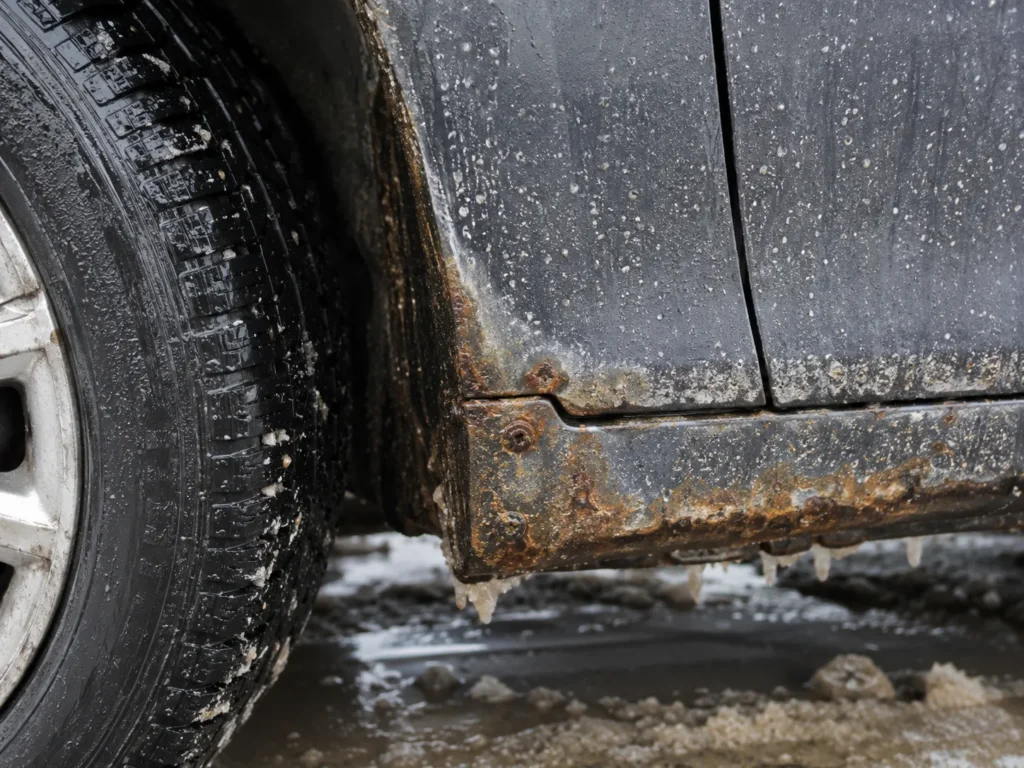
- rust staining;
- bubbling paint;
- corrosion around wheel arches;
- corrosion along door bottoms;
- damaged rocker-panel coatings;
- surface rust around fasteners; and
- areas repeatedly blasted by road debris.
An inspection after a particularly demanding winter can identify damage before another winter begins.
DIY Rustproofing Spray vs Professional Rustproofing
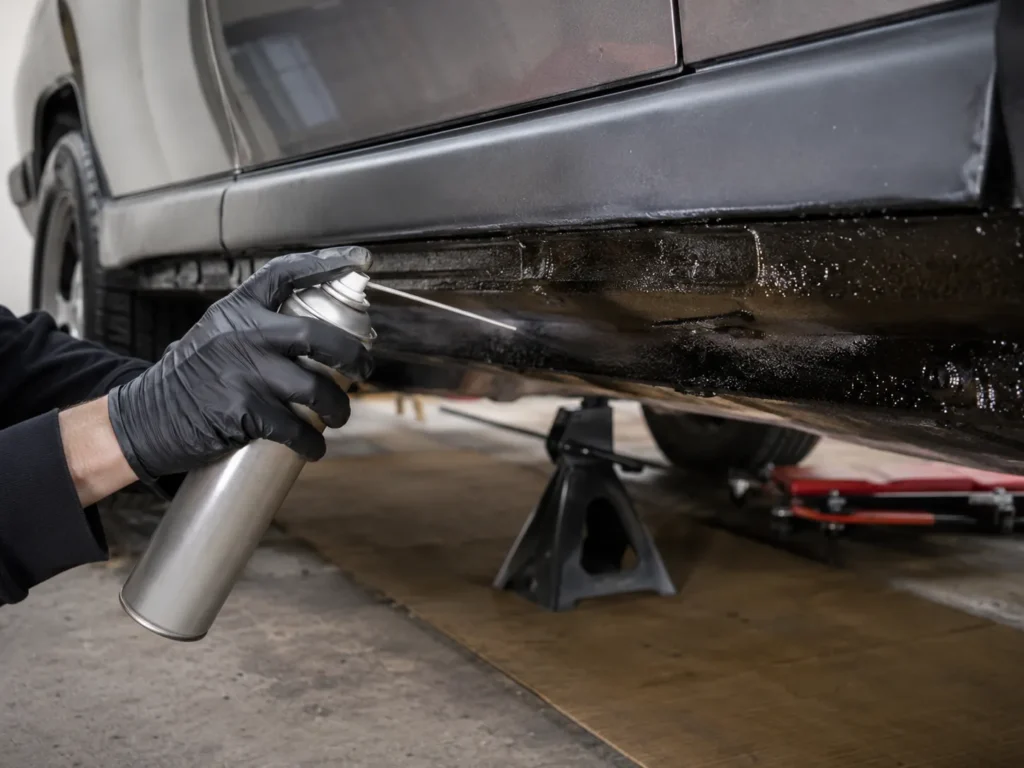
A retail rustproofing spray can be useful for certain accessible areas, especially when maintaining existing protection.
However, DIY rustproofing has limitations.
Advantages of DIY Rustproofing
- Lower initial cost
- Convenient for small touch-ups
- Useful for accessible areas
- Allows frequent inspection while working
Disadvantages
- Limited access to enclosed cavities
- Difficult to achieve consistent coverage
- Vehicle must be safely lifted if underside access is required
- Incorrect products can be applied to inappropriate surfaces
- Existing corrosion may be overlooked
- Some components must remain completely free of coating
Never spray corrosion products indiscriminately over brake friction surfaces, hot exhaust components, belts, or areas the vehicle/product manufacturer identifies as unsuitable.
Professional equipment often includes application wands capable of reaching rocker panels, door cavities, frame openings, seams, and other hidden locations.
For full-vehicle protection, application quality can matter as much as the product itself.
What to Ask Before Paying for Rustproofing
A trustworthy Rustproofing service provider should be able to answer specific questions.
Ask What Product They Use
Is it:
- creeping oil;
- dripless oil;
- wax;
- cavity wax;
- polymer coating;
- rubberized undercoating; or
- another corrosion inhibitor?
Ask What Areas Are Covered
“Full rustproofing” can mean different things at different shops.
Ask whether the service covers:
- doors;
- rocker panels;
- wheel wells;
- seams;
- underbody;
- frame or subframe areas;
- hatch or trunk cavities; and
- manufacturer-approved access points.
Ask About Preparation
The technician should assess dirt, moisture, loose corrosion, damaged coatings, and existing treatments before application.
Ask About Annual Inspection
Even a multi-year treatment benefits from inspection.
Ask About the Warranty
Find out:
- what corrosion is covered;
- whether annual inspection is mandatory;
- whether touch-ups cost extra;
- whether coverage transfers to another owner; and
- what conditions void the warranty.
Ask About Your Vehicle Warranty
Check the manufacturer documentation yourself rather than relying entirely on a salesperson.
Pros and Cons of Rustproofing
Benefits
Rustproofing may:
- reduce metal exposure to moisture and salt;
- protect seams and cavities;
- slow corrosion development;
- help preserve hard-to-replace body areas;
- complement regular cleaning;
- contribute to long-term vehicle preservation; and
- make particular sense for vehicles kept well beyond their initial ownership period.
Drawbacks
Rustproofing can also involve:
- recurring service costs;
- oily residue or dripping with some treatments;
- annual inspections;
- difficult cleanup;
- compatibility issues with existing coatings;
- possible warranty considerations;
- unnecessary application if the wrong product is chosen; and
- problems caused by poor surface preparation or poor workmanship.
The service itself is not automatically good or bad.
Product selection and application quality determine much of its value.
Common Rustproofing Misconceptions
“A New Car Cannot Rust”
Modern corrosion protection is much better than it once was, but damage, abrasion, road salt, paint chips, repairs, and ageing can eventually create vulnerable areas.
“Rustproofing and Undercoating Are the Same Thing”
They overlap, but they serve different purposes. Penetrating rustproofing focuses heavily on corrosion-prone seams and cavities, while undercoating generally creates a more durable external barrier beneath the vehicle.
“A Permanent Coating Never Needs Inspection”
Anything exposed beneath a moving vehicle can suffer damage.
Inspect it.
“Rustproofing Removes Existing Rust”
It does not rebuild metal or reverse structural corrosion.
“More Product Means Better Protection”
Excess product in the wrong location can create problems.
Correct coverage matters more than volume.
“Rustproofing Means You Can Stop Washing Your Car”
Rustproofing complements cleaning; it does not replace it.
A Practical Canadian Rust-Prevention Routine
Rust prevention works best as a maintenance system rather than a single service.
Before Winter
- inspect the current rust protection;
- repair damaged paint;
- address visible corrosion;
- apply or refresh treatment when required; and
- check vulnerable wheel-well and underbody areas.
During Winter
- remove heavy salt and grime regularly;
- use underbody rinsing where appropriate;
- keep drainage areas clear; and
- inspect significant paint or underbody damage.
Toyota Canada, for example, recommends regular winter washing with attention to the undercarriage, wheel wells, and lower panels to reduce salt accumulation.
Suggested citation: Toyota Canada — Protect Your Vehicle From Winter Roads.
After Winter
- thoroughly clean accumulated winter contamination;
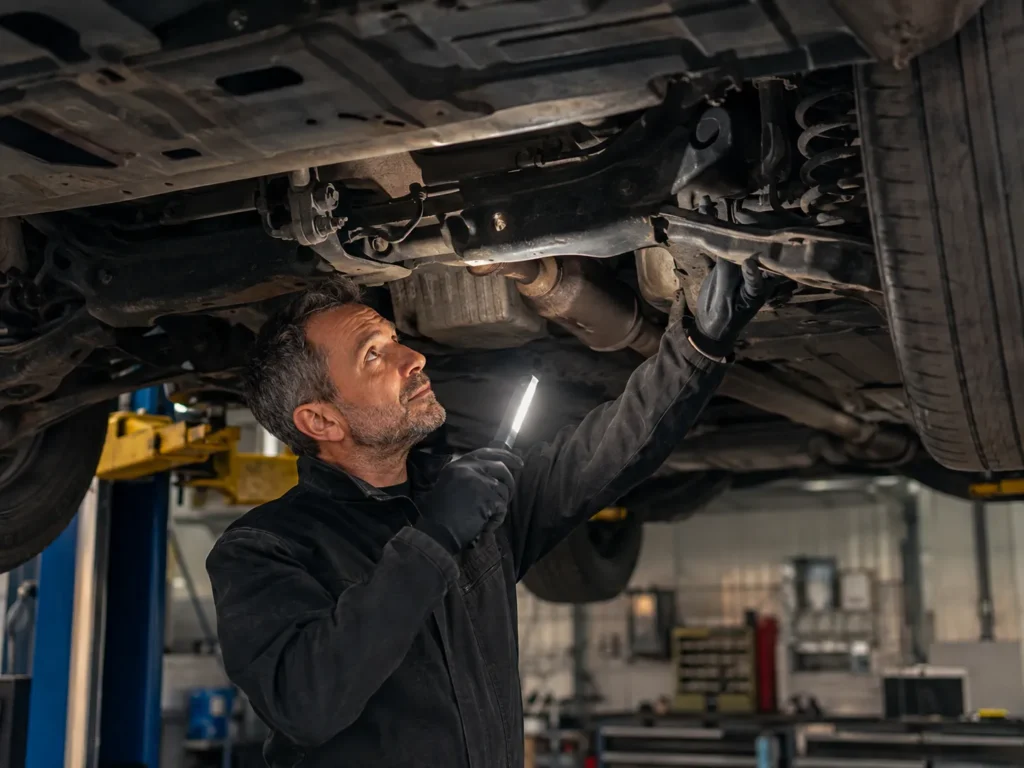
- inspect the underside;
- repair stone chips;
- look for coating damage; and
- schedule touch-ups if necessary.
Rustproofing works best when the rest of the vehicle is maintained as well.
Practical Examples
Example 1: Daily Montreal Commuter
A five-year-old sedan travels 20,000–25,000 kilometres annually and is driven throughout winter.
Practical approach: Inspect every year. If using penetrating oil rustproofing, annual reapplication is reasonable because exposure is frequent and winter roads are salted.
Example 2: Low-Mileage Summer Car
A sports car travels 4,000 kilometres annually and remains stored in a dry location throughout winter.
Practical approach: Annual inspection remains useful, but full yearly reapplication may not be necessary if the existing system remains in good condition.
Example 3: Older Used SUV With Unknown History
An eight-year-old SUV has some visible surface rust and no service records.
Practical approach: Have the underside and vulnerable structural areas inspected before applying anything. Treating significant corrosion correctly is more important than immediately covering it with rustproofing spray.
Example 4: Vehicle With Multi-Year Undercoating
A truck received a durable underbody coating two years ago.
Practical approach: Do not assume it needs either complete replacement or no attention at all. Inspect high-impact areas, seams, wheel wells, and damaged sections, then touch up or reapply according to actual condition.
How Often Should You Rustproof Your Car? Final Recommendation
For most Canadians who drive throughout winter, the safest maintenance strategy is straightforward:
Inspect your vehicle’s corrosion protection once a year. If you use an oil-based or penetrating rustproofing treatment, annual reapplication is commonly appropriate in salt-heavy conditions. If you have a longer-lasting wax or undercoating system, follow its specified service interval while continuing annual inspections and repairing damaged areas promptly.
Do not choose the interval based solely on a website, advertisement, or calendar.
Consider:
- the treatment type;
- road-salt exposure;
- annual kilometres;
- vehicle age;
- existing rust;
- previous coatings;
- manufacturer requirements; and
- the actual condition of the protection.
Good rust prevention is not about applying the most product.
It is about keeping vulnerable metal protected year after year.
Frequently Asked Questions
How often should you rustproof your car in Canada?
For vehicles driven regularly through salted Canadian winters, annual inspection is recommended. Many penetrating or oil-based rustproofing systems are reapplied yearly, while longer-lasting systems should follow their manufacturer’s service schedule.
Should I rustproof my car every year?
If you use an annual oil-based treatment or drive heavily in salted conditions, yearly rustproofing is reasonable. A durable coating may only require inspection and touch-ups rather than complete annual reapplication.
How long does car rustproofing last?
It depends on the product. Penetrating oils, waxes, sealants, and thick undercoatings behave differently. Driving conditions, abrasion, salt exposure, application quality, and maintenance also affect longevity.
Is rustproofing worth it in Canada?
It can be particularly useful for vehicles that will be kept long-term and driven through road salt, slush, and wet winter conditions. Whether it is worthwhile for a short-term lease or lightly driven vehicle depends on expected ownership and exposure.
What is the difference between rustproofing and undercoating?
Rustproofing generally focuses on corrosion prevention, including hidden seams and cavities. Undercoating normally creates a thicker protective layer beneath the vehicle to resist moisture, salt, gravel, and physical abrasion.
Can you rustproof over existing rust?
Minor corrosion may sometimes be treated and protected, but significant rust should be inspected first. Rustproofing cannot restore metal that has already deteriorated.
Is oil rustproofing better than undercoating?
Neither is automatically better. Penetrating oils work well in seams and enclosed areas, while undercoatings offer greater resistance to physical abrasion on suitable exposed surfaces. Some corrosion-control strategies use both types of protection.
What is the best time of year for rustproofing?
Late summer and early fall are convenient because they allow protection before winter road-salt exposure. However, a vehicle that needs treatment should not wait an entire year simply because autumn has passed.
Should you wash a car before rustproofing?
The surface condition should meet the rustproofing product manufacturer’s application requirements. Heavy dirt, salt, loose corrosion, or contamination may need to be removed beforehand. Ask the applicator how the vehicle is prepared.
Does washing remove rustproofing?
It depends on the product and washing method. Properly applied coatings are designed for automotive exposure, but aggressive pressure washing in treated areas may shorten the life of some products. Follow the treatment provider’s maintenance instructions.
Does a new car need rustproofing?
Not necessarily. Modern vehicles already include factory corrosion protection. Additional rustproofing can make sense for long-term ownership in high-salt environments, but check the owner’s manual and corrosion-warranty terms before applying aftermarket products.
Can electric cars be rustproofed?
Often yes, but application must follow the EV manufacturer’s requirements. Battery systems, high-voltage equipment, connectors, sensors, drainage paths, and other areas may have specific restrictions. Choose a provider familiar with the vehicle.
How do I know when rustproofing needs to be reapplied?
Look for exposed metal, missing oil film, damaged coating, cracking, separation, corrosion staining, or areas disturbed during repairs. An annual professional inspection is the simplest way to determine whether complete reapplication or only touch-ups are needed.