

If you are wondering how long to wait to wash car after rustproofing, the safest answer is: follow the instructions for the exact product applied to your vehicle. Some penetrating oil-based rustproofing products allow washing immediately or within 24 hours, while thicker underbody coatings may require five to seven days before exposure to an automatic car wash or high-pressure underbody spray.
If you do not know what product was used, avoid high-pressure washing of the treated underbody for about one week. You can usually clean contaminated paint or glass sooner without directing strong water pressure at treated areas.
How Long to Wait to Wash Car After Rustproofing: Quick Answer
There is no universal waiting period because different rustproofing products behave differently.
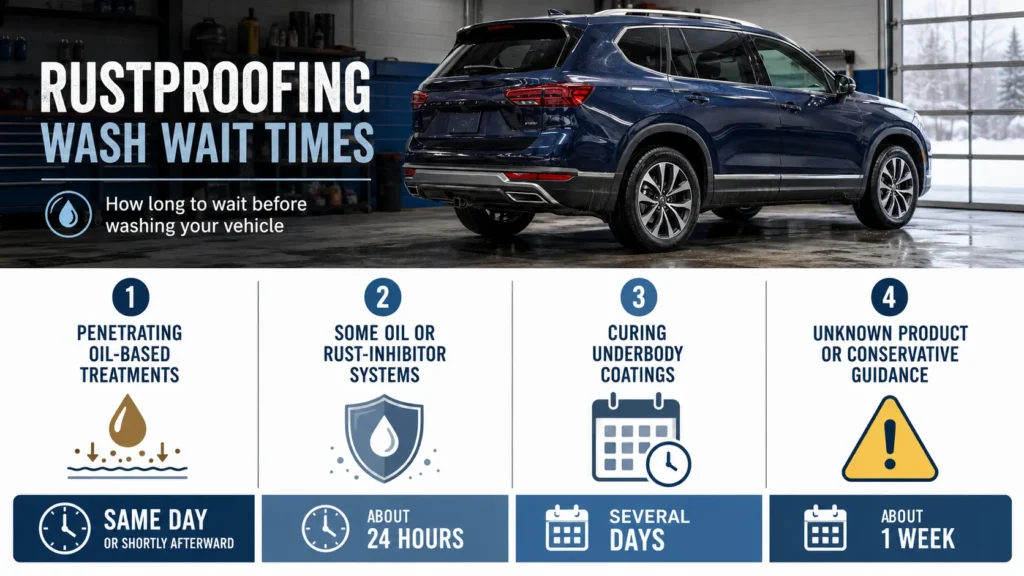
| Rustproofing guidance | When washing may be allowed | Important restriction |
|---|---|---|
| Penetrating oil-based treatments | Same day or shortly afterward for some products | Avoid aggressive spraying if the manufacturer specifies a settling period |
| Some oil/rust-inhibitor systems | After about 24 hours | Avoid heavy pressure directly on treated panels |
| Curing underbody coatings | Several days | High-pressure or underbody washing may need to wait |
| Some professional undercoating systems | About one week | Avoid car washes and pressure washing during the curing period |
| Product unknown | Use a conservative one-week window for underbody washing | Contact the installer if you need to wash sooner |
Practical rule: if your installer gave you a specific waiting period, follow it. If you received no aftercare instructions, waiting seven days before a high-pressure or automatic underbody wash is a sensible conservative approach.
A gentle exterior wash is a different situation. Washing the painted body, windows and windshield does not necessarily expose the protected undercarriage to the same pressure or chemicals.
Why the Waiting Period Varies So Much
The word rustproofing describes several different corrosion-control methods rather than one standardized coating.
That distinction matters.
Some rustproofing products remain soft, oily or mobile so they can penetrate seams and displace moisture. Others form a thicker waxy, rubber-like or relatively firm protective film. A product that remains active and pliable does not “cure” in the same way as a coating designed to dry into a solid barrier.
For example, some lanolin-based corrosion inhibitors are deliberately non-drying. Other automotive underbody products form firmer films after application.
That is why advice such as “always wait 24 hours” or “always wait four weeks” can be misleading. The chemistry of the treatment matters more than a universal countdown.
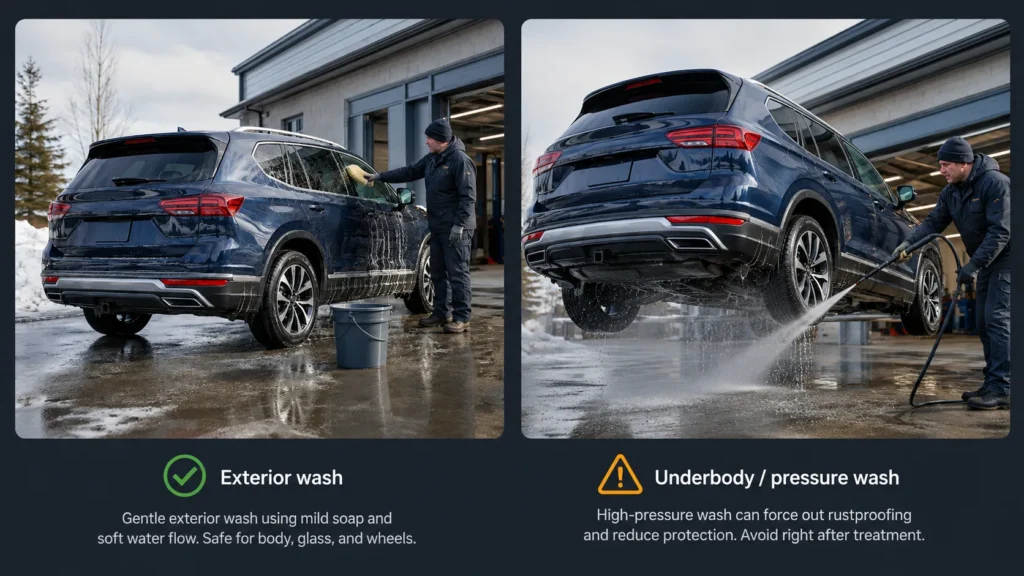
Washing the Exterior Is Not the Same as Washing the Underbody
This is one of the most important distinctions when deciding whether to wash car after rustproofing.
Exterior washing
A normal exterior wash primarily cleans:
- paint
- glass
- mirrors
- wheels
- exterior trim
If rustproofing overspray appears on the paint or glass, many professional installers clean these surfaces before returning the vehicle.
In fact, some rustproofing companies include an exterior wash as part of the application process.
Underbody washing
An underbody wash sends water toward areas where rust inhibitor may have been applied, including:
- chassis components
- wheel wells
- rocker areas
- seams
- frame sections
- floorpan surfaces
A strong undercarriage spray can exert much more mechanical force on a freshly applied protective film than ordinary rain or a gentle exterior rinse.
Pressure washing
Pressure washers deserve additional caution because the concentrated water stream can directly strike recently treated surfaces.
Even after the initial waiting period, avoid placing a pressure-washer nozzle extremely close to a protected surface unless the product manufacturer specifically states that the coating can tolerate it.
What Different Rustproofing Manufacturers Actually Recommend
Real manufacturer and service-provider guidance shows why product-specific advice matters.
Krown: Its professional application process includes washing excess product from painted exterior surfaces after rustproofing. Krown also states that soap and water do not remove the active rust inhibitor from the metal.
Corrosion FREE: The company states that vehicles can be washed after treatment but advises against underbody sprays containing degreasers because these can reduce the product’s longevity.
Rust Check: Its guidance allows washing after treatment but recommends avoiding heavy power washing directly on treated panels for at least 24 hours.
ValuGard: Its Canadian guidance states that the products can take up to one week to fully cure and recommends avoiding car washes or pressure washing of the vehicle underbody for that period.
NAPA AUTOPRO also gives a conservative general recommendation of waiting at least one week after applying a rustproofing product.
These examples demonstrate the central point: the correct waiting period depends on the rustproofing system, not simply on the fact that your vehicle was rustproofed.
Does Rustproofing Need to “Dry”?
Sometimes—but not always.
The better question is whether your specific treatment needs to dry, cure, settle or penetrate.
Penetrating oil-based rustproofing
Oil-type treatments are designed to migrate into seams and other difficult-to-reach areas. Some remain active rather than drying into a hard shell.
You may notice dripping shortly after application. With Krown, for example, the company says most excess dripping occurs during the first 24 to 48 hours.
Dripping does not automatically mean the rustproofing failed. It may simply be excess material leaving the vehicle after the product has moved into seams and crevices.
Lanolin-based treatments
Some lanolin-based products also remain soft and pliable rather than drying hard. Fluid Film, for example, describes its automotive coating as non-drying and soft.
Because these films remain active, the concept of waiting for them to “fully harden” does not apply in the same way it does to a rigid coating.
Wax or firmer underbody coatings
Wax-based and other coating-style products may need time for solvents or water carriers to leave the coating and for the protective layer to reach its intended properties.
Aggressive washing too soon can therefore be more important with some of these systems.
The technical data sheet for the exact product should always take priority over generic internet advice.
Can You Go Through an Automatic Car Wash After Rustproofing?
Yes, eventually, but check whether the wash includes an undercarriage spray.
That feature makes a major difference.
An exterior-only automatic wash may present relatively little risk to treated underbody areas. A touchless wash with powerful underbody jets can directly spray the freshly protected surfaces.
If your rustproofing product has a specified curing or settling period, wait until that period has passed before selecting an underbody wash.
If you cannot identify the product, waiting approximately one week before an automatic wash with an undercarriage cycle is the safer choice.
Is a Touchless Car Wash Safe After Rustproofing?
“Touchless” does not necessarily mean gentle on rustproofing.
Touchless washes often rely on a combination of:
- higher-pressure water
- stronger cleaning chemicals
- pre-soaks
- optional underbody jets
The lack of brushes protects paint from physical contact, but the water pressure and chemistry may still affect certain rust inhibitors.
Pay particular attention to products that warn against degreasers. Degreasing chemicals can remove or thin oily protective films more effectively than ordinary automotive shampoo.
Can You Pressure Wash a Car After Rustproofing?
Yes, once the treatment is ready for it—but use sensible technique.
Avoid aiming a concentrated pressure-washer stream at recently treated seams, cavities, drain openings or coated underbody surfaces during the initial settling or curing period.
Afterward, maintain enough nozzle distance to clean dirt and salt without deliberately stripping the protective film.
If you regularly pressure wash the underbody because of mud, off-road use or winter salt, ask the rustproofing provider whether your treatment needs more frequent inspection or touch-ups.
What Happens If It Rains After Rustproofing?
Normal rain is usually much less aggressive than a high-pressure car wash.
Many penetrating rust inhibitors are specifically designed to resist or displace moisture, and some treatments can even be applied under damp conditions. However, coating systems vary, so manufacturer instructions still matter.
If your installer says the vehicle is ready to drive immediately, normal wet roads or rain generally should not be treated as equivalent to pressure washing the undercarriage.
For a coating that has specific moisture-related curing requirements, follow the installer’s aftercare instructions instead.
What If You Accidentally Wash the Car Too Soon?
Do not assume you have ruined the rustproofing.
The outcome depends on:
- the product used
- how soon the car was washed
- whether you cleaned only the exterior
- whether the wash included underbody jets
- water pressure
- cleaning chemicals
- whether a degreaser was used
A gentle exterior wash shortly after an oil-based treatment may have little or no effect on the protected areas.
A powerful underbody wash directed at a fresh coating could be more significant.
If you washed the vehicle earlier than recommended, inspect visible treated areas and contact the installer. Do not automatically add another layer of rustproofing. Excessive or incompatible product can create its own maintenance problems.
Signs the Rustproofing May Need Inspection
After an aggressive wash or during routine maintenance, look for unusual changes in accessible treated areas.
Depending on the product, potential concerns include exposed metal where a continuous coating existed previously, significant missing coverage, peeling or cracking of a hard coating, or areas where pressure washing clearly stripped material away.
Remember that a soft oil-based treatment will naturally look very different from a hard undercoating. Do not judge every product by whether it forms a thick black layer.
When in doubt, let the original installer inspect it.
Why Washing Still Matters After Rustproofing
Waiting after application does not mean you should stop washing your vehicle permanently.
This is particularly important in Canada.
Environment and Climate Change Canada reports that roughly five million tonnes of road salts are used each year as de-icers on Canadian roads. Road salts include chloride compounds and brines used during winter maintenance.
Those materials can accumulate on exposed parts of a vehicle throughout winter.
Once your rustproofing treatment has passed its initial post-application period, appropriate washing helps remove salt, mud and road contamination from surfaces that remain exposed.
Rustproofing and washing therefore serve complementary purposes:
Rustproofing creates corrosion protection. Washing reduces the contaminants attacking the vehicle.
For a deeper explanation of different protection methods, see our guide to Rustproofing.
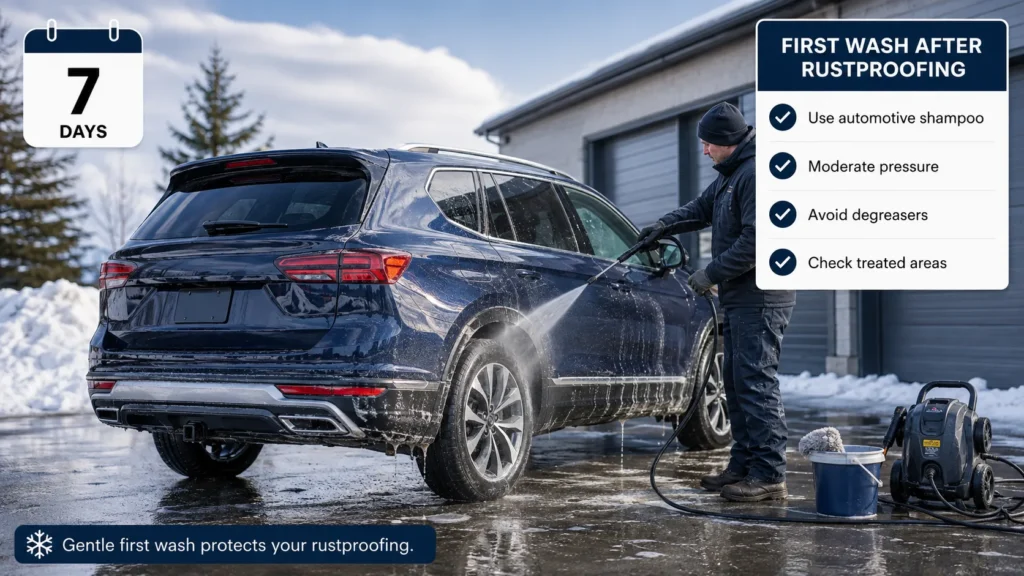
How to Perform the First Wash After Rustproofing
Once the recommended waiting period has passed, use a cautious first wash.
- Confirm the treatment’s aftercare instructions.
- Start with normal automotive shampoo rather than a strong degreaser.
- Wash painted surfaces and glass normally.
- Use moderate water pressure around wheel wells and treated lower areas.
- Do not hold a pressure-washer nozzle close to newly treated surfaces.
- Avoid aggressive underbody chemicals unless the rustproofing manufacturer approves them.
- Check visible treated areas afterward for unexpected coating loss.
You may see some oily residue or excess material around drain areas after certain penetrating treatments. This can be normal, especially shortly after application.
Should You Wash the Car Before Rustproofing?
Usually, the underbody needs to be sufficiently clean for the chosen treatment, but preparation requirements differ by system.
Heavy mud can block access to metal and prevent proper inspection. Some coating systems also require a clean, dry surface before application.
Other moisture-displacing rust inhibitors can be applied to damp surfaces.
For example, DINITROL’s coating instructions emphasize proper cleaning and drying for its multi-layer corrosion-protection process, while Corrosion FREE states that its treatment can be applied when a vehicle is wet.
The takeaway is the same: surface preparation should match the product being applied.
A reputable installer should know the preparation requirements rather than following the same process for every rustproofing chemical.
Common Misconceptions About Washing After Rustproofing
“You can never underbody wash a rustproofed vehicle.”
Not necessarily. Many rustproofing systems tolerate normal washing once any required settling or curing period has passed.
The concern is usually aggressive pressure, unsuitable chemicals or washing too soon—not water itself.
“Every rustproofing product needs a week to dry.”
False. Some penetrating oil and lanolin treatments intentionally remain soft or active.
Other coatings do require more drying or curing time.
“If rustproofing drips, something went wrong.”
Not necessarily. Penetrating treatments may release excess product after application. Dripping behaviour depends on the formulation and quantity applied.
“A touchless wash cannot affect rustproofing.”
Touchless washes eliminate brushes, but they can still use high-pressure water, undercarriage jets and strong chemicals.
“The longer you avoid washing, the better.”
Not automatically. Once the treatment is ready, allowing road salt and contamination to remain on exposed areas indefinitely provides no benefit.
Waiting Longer vs. Washing Earlier: Pros and Cons
| Approach | Advantages | Possible drawbacks |
|---|---|---|
| Waiting through the recommended cure/settling period | Gives the treatment time to achieve its intended condition and reduces the risk of disturbing fresh material | Dirt or salt may remain temporarily on exposed surfaces |
| Gentle exterior cleaning sooner | Removes bird droppings, dirt or overspray from paint without necessarily affecting the underbody | Careless spraying may reach treated areas |
| Early high-pressure underbody wash | Removes mud or salt quickly | Can disturb certain freshly applied treatments |
| Washing normally after the approved waiting period | Helps control salt and road contamination | Harsh chemicals or extremely close pressure washing can still shorten the life of some soft films |
Rustproofing Maintenance Tips for Canadian Drivers
Rust protection works best as part of an ongoing maintenance plan rather than a one-time application followed by years of neglect.
After the initial waiting period, keep the vehicle reasonably clean during salt season. Pay attention to wheel wells, rocker areas and exposed underbody components while respecting the cleaning limitations of the product.
Have the treatment inspected at the interval recommended by the provider. Some penetrating systems use annual applications, while other products operate on different service schedules.
Repair chipped paint and exposed bare metal promptly. Rustproofing underneath the vehicle does not replace maintaining the factory paint system.
If you frequently drive on gravel roads, through deep snow, on salted highways or off-road, inspect vulnerable areas more often because abrasion can affect protective coatings.
How to Choose a Rustproofing Service
When comparing rustproofing for a car, do not choose a provider based only on price or claims about how many years the treatment lasts.
Ask the installer:
- What exact product will you apply?
- Is it penetrating oil, lanolin, wax or another coating system?
- Does the treatment dry hard or remain soft?
- How long before I can wash the exterior?
- How long before I can use an automatic underbody wash?
- Are pressure washers safe?
- Which soaps or degreasers should I avoid?
- How often should the treatment be inspected or reapplied?
- What preparation is performed before application?
- What does the warranty require?
- Can I receive the post-treatment instructions in writing?
Clear answers to these questions are a useful sign that the shop understands the product it applies rather than relying on generic rustproofing advice.
If you are still deciding whether the service makes sense for your vehicle and ownership plans, read Is Rustproofing Worth It.
How Long Should You Wait in Different Situations?
You know the product and received instructions
Follow those instructions exactly. They override general recommendations.
You had penetrating oil rustproofing applied
Some products allow normal exterior washing immediately, although the manufacturer may recommend avoiding heavy pressure on treated surfaces for a short period.
You had a hard or curing undercoating applied
Allow the specified curing time before exposing it to an underbody car wash or pressure washer.
You do not know what product was used
Avoid high-pressure underbody washing for approximately one week and contact the installer for the exact aftercare recommendation.
You urgently need to remove bird droppings or another paint contaminant
Clean the affected exterior area carefully rather than leaving damaging contamination on the paint simply because the vehicle was recently rustproofed. Avoid directing high-pressure water toward treated lower-body or underbody areas.
FAQ About Washing a Car After Rustproofing
Can I wash my car 24 hours after rustproofing?
Possibly. Some rustproofing systems permit washing after 24 hours or even sooner, while other coatings need several days to cure. Check the specific product instructions before using a pressure washer or underbody car wash.
Can I wash my car the same day as rustproofing?
Some oil-based systems allow it. Certain professional rustproofing services even clean the exterior immediately after application. That does not mean same-day washing is appropriate for every undercoating product.
Will a car wash remove rustproofing?
A normal wash should not remove a properly applied, wash-resistant rustproofing system once it is ready for service. However, high-pressure water, aggressive degreasers or premature washing can reduce some products’ protective film.
Can I use an underbody wash after rustproofing?
Yes, if the product allows it and the required cure or settling period has passed. Because an underbody wash directly targets treated surfaces, it deserves more caution than washing the exterior.
How long should I wait before pressure washing after rustproofing?
The answer is product-specific. Published recommendations range from approximately 24 hours for some treatments to about one week for other underbody coatings. If the product is unknown, a one-week wait is a reasonable conservative approach.
Does rain wash off fresh rustproofing?
Normal rain usually creates far less pressure than an automatic underbody wash or pressure washer. Many penetrating corrosion inhibitors are designed to repel or displace moisture. Still, follow any specific moisture or curing restrictions supplied with your coating.
What happens if I wash my car too early after rustproofing?
You may experience no problem at all, especially if you only washed the exterior. If you used a high-pressure underbody wash before the recommended waiting period, ask the installer to inspect the treatment rather than assuming it must be completely reapplied.
Should I avoid degreaser after rustproofing?
For some treatments, yes. Degreasers are designed to remove oils and grease, which means they can shorten the life of certain oily corrosion-protection films. Corrosion FREE specifically advises against underbody sprays containing degreasers.
Is rustproofing the same as undercoating?
Not always. Rustproofing is a broad term covering corrosion-control treatments, while undercoating often refers to a protective layer applied mainly to the underside of a vehicle. Penetrating rust inhibitors may also be applied inside doors, rocker panels, seams and other cavities where traditional undercoating cannot reach.
How often should I wash a rustproofed car during a Canadian winter?
There is no fixed schedule for every driver. Once the initial post-treatment restriction has passed, wash often enough to prevent heavy salt and grime accumulation while following your product’s instructions regarding underbody pressure and cleaning chemicals. Driving conditions, snowfall, road-treatment practices and where the vehicle is stored all affect the ideal frequency.
Should I rustproof before or after winter?
Many rustproofing systems can be applied throughout the year. The most important factors are correct preparation, proper application and maintaining protection according to the manufacturer’s schedule. Do not delay necessary corrosion protection solely because winter has already started.
Final Answer: How Long to Wait to Wash Car After Rustproofing
So, how long to wait to wash car after rustproofing? There is no single waiting period that applies to every product.
Some penetrating rustproofing treatments can tolerate exterior washing immediately or shortly after application. Other systems recommend avoiding heavy pressure for at least 24 hours, while curing underbody coatings may require five to seven days or longer according to their technical instructions.
If you know the product, follow its manufacturer’s guidance. If you do not know what was applied, avoid a high-pressure or automatic underbody wash for about one week and contact the installer for confirmation.
After that initial period, do not become afraid of washing your vehicle. Appropriate cleaning and properly applied rust protection work together—especially in Canadian conditions where winter road salt, brine, slush and moisture create an ongoing corrosion challenge.